| Pace | Words per minute | Words in 5 minutes |
|---|---|---|
| Slow | 110 | 550 words |
| Average | 130 | 650 words |
| Fast | 160 | 800 words |
Your own pace may be outside this range. Read a short passage out loud on the words to minutes calculator to measure it, then paste your speech there to get its exact length.
Sample five minute speech
A five minute talk, 651 words. Read it out loud and time yourself to hear what five minutes feels like.
A year ago I couldn't record a thirty second video without stopping six times. Today I want to tell you what changed, because it wasn't talent, and it wasn't confidence. It was three small habits, and you can start all of them this week.
Let me take you back to my first attempt. I had a script written out on my laptop, and I'd propped my phone up on a pile of books. I pressed record, said the first line, and then my eyes drifted down to the laptop to check the next one. When I watched it back, I looked like I was reading a shopping list off the floor. So I tried to memorise it. That was worse. I'd get halfway through, lose a word, and freeze. Forty minutes later I had one usable take, and I hated it.
The first habit that changed things was writing the way I talk. My old scripts sounded like essays. Long sentences, clever words, the kind of thing that looks good on a page and sounds strange out loud. So I started writing short lines. One idea per line. Contractions everywhere. If a sentence made me take a breath in the middle, I cut it in two. And here's the test I still use. I read every line out loud before I record. If I wouldn't say it to a friend across the table, it doesn't go in.
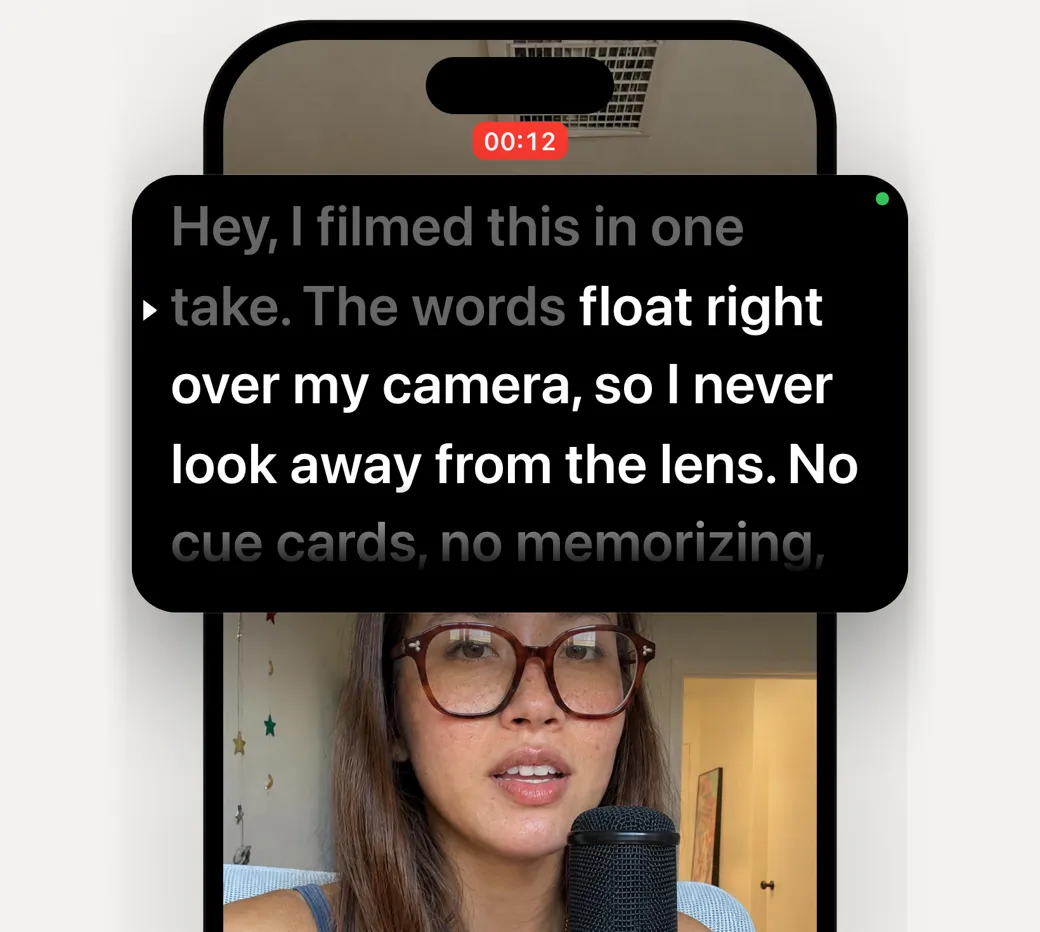
The second habit was keeping the words next to the lens. This sounds obvious, but it took me months to work out. Your audience can tell exactly where your eyes are. If the script is below the camera, you look down. If it's off to the side, you look shifty. When I moved the text right up next to the lens, small enough that my eyes barely moved, people started commenting that I seemed more relaxed. I wasn't. I was just looking at them.
The third habit, and the one that made the biggest difference, was letting myself pause. I used to think every silence was a mistake, so I'd rush. I'd fill gaps with um and so and basically. Then a friend who does radio told me something I've never forgotten. She said the pause is where the listener catches up. When you stop for a second after an important point, it lands. When you rush past it, it's gone.
So I started building pauses into my scripts. Literally. A line break means breathe. A blank line means stop and let it sit. My videos got a little longer, and people watched more of them, not less.
Now, I want to be honest about what didn't change. I still get nervous. I still do more than one take. Last week it took me four tries to say the word particularly, and I eventually gave up and said especially instead. The difference is that now a bad take is a small thing, not a reason to quit for the day.
If you're where I was a year ago, here's what I'd do. Tonight, write a script for a sixty second video about something you know well. Write it in short lines, the way you'd say it. Read it out loud once and fix anything that trips you up. Then put the words as close to your camera lens as you can, and record it. Don't watch it back straight away. Record it three times, then pick the best one.
It won't be perfect. Mine weren't. But it will be better than the version that stays in your head, because nobody gets to see that one.
The people we enjoy watching aren't the ones who never stumble. They're the ones who look at us like we're in the room with them, say something they mean, and give it a moment to land. You can do all three of those things, starting this week.
Thank you.
How to plan 650 words
| Part | Words | What goes in it |
|---|---|---|
| Opening | 65 words | A hook and a promise of what's coming |
| Point one | 170 words | Make it, then back it up with an example |
| Point two | 170 words | Same shape, different idea |
| Point three | 170 words | Save your strongest point for last |
| Close | 75 words | Sum up and give one action |
Tips for a 5 minute speech
- Five minutes holds three points comfortably. A fourth usually means rushing all of them.
- Give each point the same shape: say it, show an example, say what it means for the listener.
- If you're presenting slides, plan for fewer words. Talking over a slide change takes a few seconds each time.